Attack Pattern Blast Four
Read In Order
Action Faction Sponsors: WOLVERINE
Progress Towards Next New Book Sent to Schools
$15/$50
“Point November, flight lead. Estimated time to intercept track Aquarian Ten two minutes.” Meerkat’s voice was all-business. It was the missions that seemed to be simple and un-threatening that often turned out to be surprisingly perilous. For that reason both of the fighters in the Cavalier Three formation were leaving nothing to chance. Everything was being conducted by the book. For purposes of EM protocol, point November represented the range from launch point at which it was no longer hazardous to transmit in the clear. Lieutenant Mors allowed the regulation ten second response interval to pass, then he set his helmet patch to transmit hailing.
“Attention unidentified vessel at two eight mark nine. This is Alliance patrol Cavalier Three on your port quarter. Acknowledge.” In addition to the voice signal, Bongo’s fighter automatically transmitted universal Core System “friendly” and “priority” data packet bursts compatible with almost all commercial and civilian navigation systems. Even if the ship’s communications were completely turned off (which would qualify as a second STC violation to go with the deactivated transponder) the vessel’s universal console and navigational tracking systems would zero in on the transmitting fighters and display a warning along the lines of “Turn on your radio/commlink/transponder device/personal commlink/what have you and follow the instructions you hear – this is not optional.”
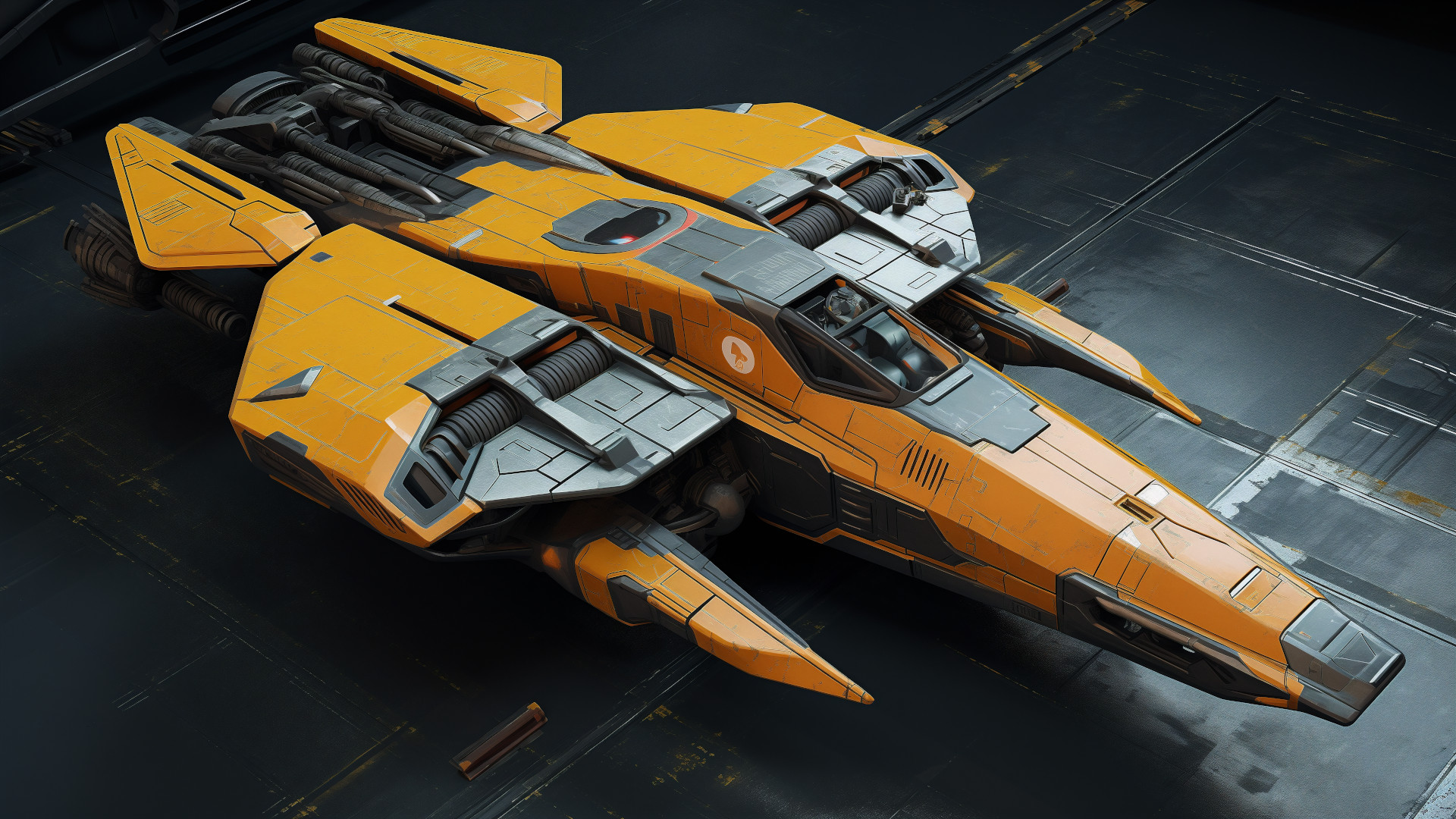
The two Yellowjacket fighters were not in any kind of attack posture, but they were listening very carefully to everything happening in and around the position of the civilian vessel. Lieutenant Walsh had Aquarian Ten locked in her SRS systems and by now had identified the model of spacecraft and its displacement. She was also reading five life signs, all human.
Aboard Argent, Commander Shaw turned away from the force command station and slipped her headphones off. “Patrol Cavalier Three has intercepted Aqaurian Ten, sir.”
O’Malley moved back to the conn. “Which button?”
“Four, sir.”
The commander pulled the gray handset off its hook. “Cavalier Three, this is X-ray Oscar. What have you got?”
“Civilian yacht, sir. Displacement just under four thousand tons. High-end long-range engines. Standard power plants. Reading five life signs. No unusual activity or readings. Still no transponder signal. No communications. Basically civvie EMCON alpha.”
“Any change in course?” O’Malley asked as he looked back at the tactical display. His readings hadn’t changed, but that didn’t mean the fighters were getting the same information.
“Still on original course and speed, sir,” Bongo replied. “I’d say they’re on some kind of system-to-system autopilot inbound to one of the inner Rho Theta ports.”
“And at this course and speed?”
“About 18 hours to the closest civilian approach.”
O’Malley sighed. There was no avoiding the regs. “Alright, rattle the cage until the birds are awake. We’re going to have to stop them once they cross the perimeter anyway. We will rendezvous at point two. Argent out.”
“Affirmative Argent. Vectoring for loud intercept. Will report on response.”
Once any ship passed a certain range from a populated system’s primary, spacelane regulations required someone at the controls, even if the ship were being maneuvered with a standard autopilot or programmed navigation. The reasons dated back to an incident over a century before Cavalier Three detected their transponder-dark contact. A passenger ship with nearly sixty souls aboard had connected with a civilian spaceport’s equivalent of the old ILS or Instrument Landing System beacon. The way the mechanism was supposed to function was to negotiate a protocol and then take over the ship’s controls and bring it in for a gentle landing. The regulations at the time were for the pilot of the inbound vessel to manually switch the autopilot off and allow the port to acquire lock. On this vessel, however, the pilot was late returning from a break and the other members of the flight crew didn’t see the request on the flight deck’s console. The passenger spacecraft veered more than a half-mile out of its approach track and was on a collision course with a massive space train carrying hazardous waste from an orbital chemical factory when every alarm on the flight deck went off at once. The crew regained control and manually brought the ship in for a landing without injury or further incident. In exchange for avoiding prosecution four members of the passenger spacecraft’s crew retired abruptly, never to hold flight status again. Two members of the spaceport’s control watch were suspended for a year. All of the Core approach protocols were re-examined and adjusted and all the automated flight controllers were updated to match the new rules.
Unfortunately, not all civilian spacecraft owners were as conscientious about navigation as they were supposed to be.
Bongo’s fighter was equipped with multiple transmitters that operated in both full military and civilian spectra. They were also rather generously equipped with power and signal boost capabilities. The antennas on most spacecraft were sufficient for getting a clear signal from place to place. Yellowjacket strike fighters had considerably more sturdy models, given they were often called upon to get a signal through despite enemy jamming, electronic warfare deployments and even the occasional systems failure. Fighters had triple-redundant transmitter/antenna constructs. Each system was independent of the other two, but when they were deployed in sequence they were capable of raising an unholy racket aboard spacecraft that weren’t specifically tuned to dampen alert signals.
Aquarian Ten’s flight deck began to ring like a desk model telephone the size of a small bread truck. All of her navigational scopes were shifting from positive to negative color schemes very much like the lights of emergency vehicles. If one weren’t aware of the reason for such a din, it would be easy to conclude they were about to collide with something large enough to send the passengers and crew of the ship into the great beyond with an unceremonius thud. Somewhere in the aft section of the vessel, either passengers or crew emerged from a stateroom and blundered down the central access corridor to the bridge. After a few moments of attempting to gain bearings, the universal “you cannot ignore this transmission” alert was acknowledged by the vessel’s autosystems. Bongo and Meerkat both saw the frequency shift.
TO BE CONTINUED
Progress Towards Next New Book Sent to Schools
$15/$50