Action Faction Blast Nine
Brought to you ad-free by Action Faction Sponsors: WOLVERINE
Progress Towards Next New Book Sent to Schools
$1/$50


Press play to listen
Progress Towards Next New Book Sent to Schools
$1/$50


"Put me down for a contribution of one thousand dollars." — Shane

Brought to you ad-free by Action Faction Sponsors: WOLVERINE
$1/$50


$1/$50


Brought to you ad-free by Action Faction Sponsors: WOLVERINE
$35/$50
$35/$50

Action Faction Sponsors: WOLVERINE
$35/$50
“We’ve got life signs aboard Tae San.”
The words of Commander Holt’s bridge specialist were replaying themselves over and over again in his mind. It was the news everyone suspected but nobody expected. It was the first shoe to drop. Everything that took place afterwards would either be confirmation of the commander’s evidence and the CINC’s working theory about enemy forces having fired on a Skywatch capital ship from aboard a vessel they intended to destroy.
The preliminary forensics surrounding the wreck of destroyer hull DDG 198 were no longer in dispute. All the available observable evidence clearly showed all the energy from the attack originated inside the ship, likely somewhere near the port-side deflector capacitors. There were no visible weapons impacts. There were no electronic residuals. The debris created by the explosion all followed conventional uninterrupted tracks away from the detonation point. Sai Lore had turned the clock back almost to the moment the catastrophic ordnance went off. At this point, any theory to the contrary of that established by Holt’s team would have a mountain of data and observations to overcome, to say nothing of the basic physics.
The only remaining question was how the saboteurs escaped. No escape pods were detectable anywhere inside Sai Lore’s sensor envelope. Granted the singularity was doing a tremendous job of making electronic noise, but one of the benefits of a vessel equipped with Commander Holt’s deluxe “analyze anything” scanner package was that it could cut through both radiation and electronic noise even if one or both were at positively indescribable amplification levels. Hiding from Holt’s ship was practically impossible even with the correct equipment and enough time. Unless the attackers had completely changed the physical laws of the universe since the Achilles engagement, there was no choice but to take the situation at face value.
DSS Tae San had apparently become a weapon wielded by forces hostile to Skywatch, had fired on an Alliance capital ship without provocation and had disabled that ship’s engines effectively enough to subject it to the overwhelming gravity well of the Omicron singularity. Then while Argent tumbled towards her destruction, Tae San suffered an inexplicable detonation from inside her own hull despite the fact no enemy vessel had fired on her. Then she was left behind by Admiral Hafnetz, adrift in a decaying orbit around Omicron 474.
By the time Sai Lore arrived, the mangled ship had only 12 days left before she crossed the phenomenon’s event horizon never to return.
But someone was alive aboard Tae San. Sai Lore’s mission was no longer a salvage. Now it was a rescue. And if what Holt and his team turned out to be even partially true, the ramifications would send shockwaves across the Alliance. Up to now, the anti-alarmists had done a magnificent job concealing their members, their motives and any stray evidence of their activities.
An intact Tae San would undo it all in one devastating blow. It was this above all other considerations that set Holt’s crew on edge. Did anyone else know DDG 198 had been drifting out here with survivors before now? Was there a possibility they might show up to finish Tae San off? All these things needed to be considered and most of all, kept quiet, at least for now. Opening a priority frequency back to base and alerting everyone on the command net that the most famous casualty of the Achilles engagement both survived and contained survivors could be more disastrous than the original battle.
Tae San was roughly 20,000 tons of evidence, perfectly preserved in the vacuum of space and now apparently harboring witnesses to the original attack and everything that had happened in the Achilles formation from yet a third vantage point. What emerged now would be as conclusive as a battle damage assessment could possibly get. All the questions would be answered, and the commander was willing to let the evidence lead where it must.
All this new inspiration drove the crew of the Sai Lore to a common objective: a first-hand examination of Tae San and the immediate rescue of her survivors. The ship had to be secured and it had to be evaluated. Once the systems and control check produced a picture of operational capacity post-detonation, the last piece of the puzzle would fall into place. From there, it was a simple matter of presenting the evidence to a board of inquiry and filing charges against those responsible for the attack.
The ranking bridge officer had been left in command. Holt, the ship’s doctor and his three most senior specialists had outfitted themselves with extra-vehicular activity gear, portable decon, an angel autonomous medical unit and a heavier version of the standard Copernicus trundlebot designed for both wheeled and zero-gravity survey and analysis inside a damaged ship.
Trundlebots were important for a couple of reasons. One, they didn’t require life support, which was most important because any malfunctions couldn’t harm their protective suits. Secondly, trundlebots didn’t degrade in extreme conditions like radiation discharges, extreme heat or cold or exposure to hard vacuum. They could go places humans couldn’t, especially small cramped spaces. If they were obstructed they could often saw, burn or pry their way through, and the whole time they were in operation they could beam both visual data and telemetry back to whomever was in command of the landing party.
The tendency for most ship’s captains would be to deploy as many units as possible, but the commander knew from experience that whatever might be waiting for them aboard Tae San could not be predicted with any confidence. Trundlebots were small and numerous, but there was a finite supply. Having a half-dozen of them go through the hull at high velocity and end up as permanent residents in the debris field would foreclose on their use in the future. One at a time was therefore the standard policy unless there was an extremely good reason to deviate.
$35/$50

Action Faction Sponsors: WOLVERINE
$35/$50
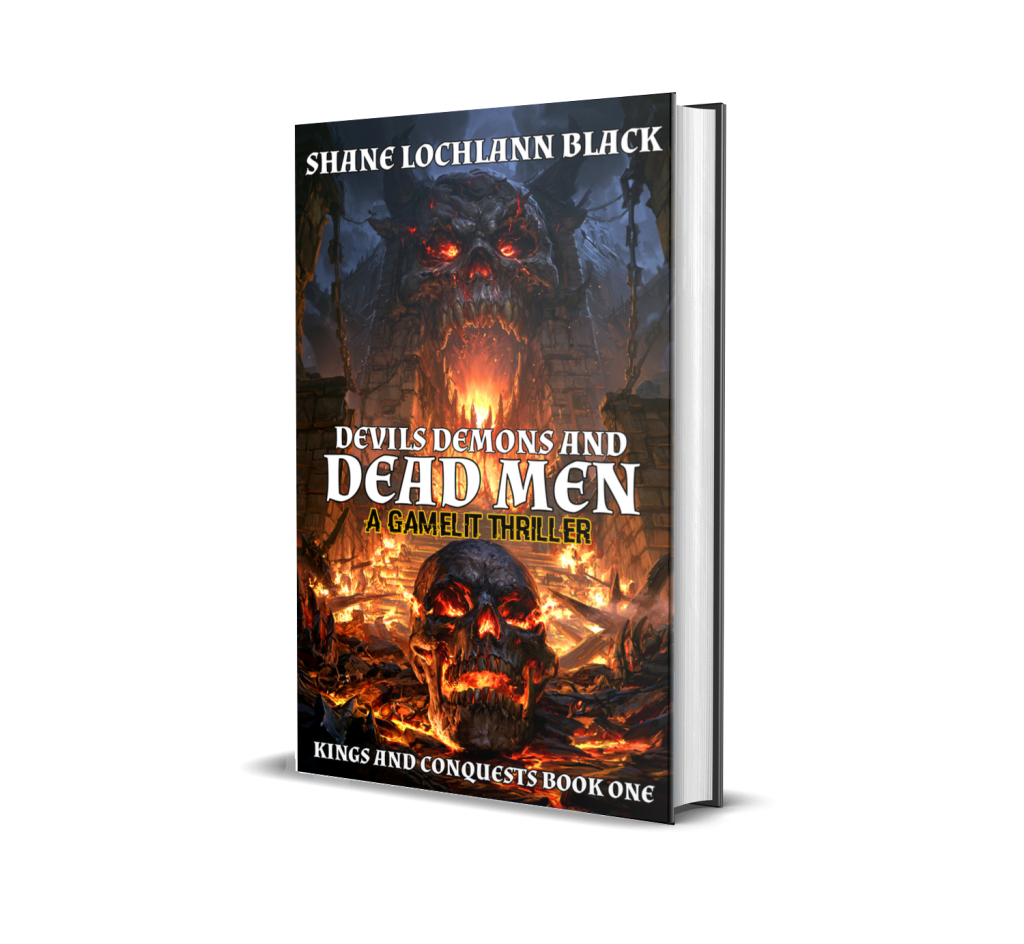
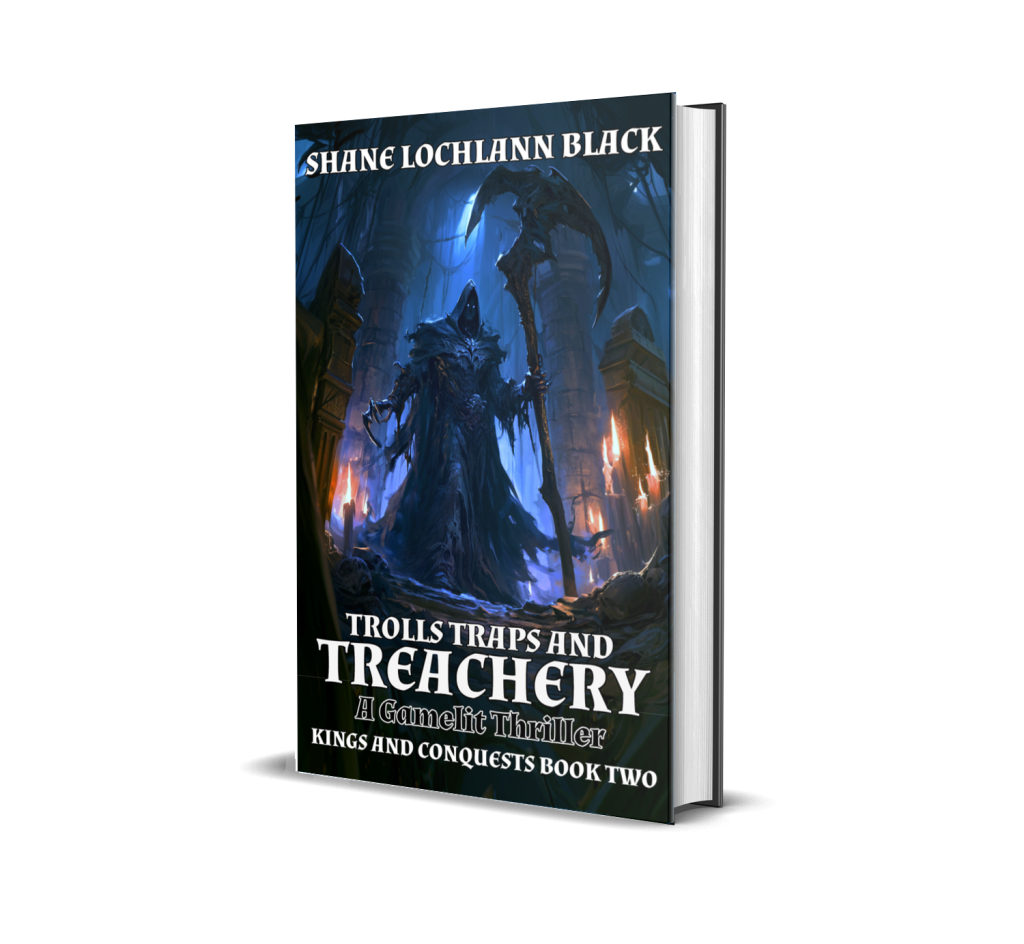
Jordan stood alone in the crowd around the PCs running the Kings and Conquests demo. He watched intently as others selected options for their characters and then launched themselves into the game world itself. Each found themselves in a rustic medieval-style Inn. By the looks of the in-game outside sky, when each demo started it was only minutes from dusk.
Finally one of the composite folding chairs opened up and Jordan sat next to a group of kids perhaps old enough to have started high school. They were enthralled by every moment of what was happening on the screen. They had chosen a character from a humanoid amphibious race capable of shape shifting into an adaptable ooze-like substance which changed colors depending on its consistency and natural defenses.
“Ooh! Take the bubble punch ability! Splat!”
“Make it so his face can turn into a sword!”
“Green goop!”
The kids jeered and shouted while the member of their group nominated to operate the PC desperately tried to keep up with their frantic suggestions. After ten minutes of teenage litigation, they managed to produce a level one character named “Doghair.”
Jordan didn’t speak. He simply observed, watching the group playing a single character in Kings and Conquests. He knew there was no chance these kids had the time or the skill to find anything of value in the game in the short interval they had before the next group took over. It was well past one in the morning, which was probably half the reason these kids were having so much fun. Jordan wondered if Mom and Dad had sent them off to GamesWest as the digital substitute for a week of summer camp. Or, he thought, maybe Mom and Dad are here too? Video games certainly weren’t limited to kids any more. Who else besides the full-time employed would be able to buy $100 in-game upgrades on a regular basis?
By now the heroic Doghair was speaking to what looked like a guardsman with the village watch. He was holding a lantern and speaking in hushed tones as if he didn’t want to be inadvertently heard. The game interface indicated the guard had three quests available. He was telling tales of disappearing livestock and bite marks infected with a terrible disease. When pressed, he said he dared not speak its name for fear the dark ones would descend on the fair village of Dayshire. Jordan concluded the disease had some kind of magical source.
Once the first of the three quests was collected from the guardsman, Doghair made his way north towards the abandoned steads where the last villager to escape said they had seen a beast in the night. The level one character was carrying everything he owned, which was to say he had a cheap lantern about half-full of fuel and a dagger scarcely wide enough to butter a dinner roll. Jordan anticipated a scene of complete higgledy-piggledy the moment anything threatening appeared. Surely the image of a ravenous werewolf attacking ten gallons of snot would be worth the wait.
“There’s a clue!”
“Where!”
“Over there!”
“Where it’s glowing!” Three fingers each attached to a different kid’s hand pointed at the screen. The fourth member of the unlikely band of adventurers guided the heroic Doghair off the road towards what looked like some kind of light source on the ground behind a scarecrow. Jordan guessed it might be an abandoned campfire. Everything else in the field was pitch black, silhouetted in the strange glow. The stars glittered overhead. On the horizon the harvest moon shone like a bronze platter suspended in a dark monarch’s throne room. Jordan had to admit Wyland’s graphics team sure could set a mood.
“It’s a lantern just like ours…” one of the kids said.
Jordan actually felt a chill. He hadn’t been this riveted to a video game in years. Like it or not, he was part of Doghair’s journey. And now the journey had a missing man.
“Which way do you think they went?” another kid asked.
“Without light?”
“Maybe they were eaten right here,” the one operating the PC said. “I’m drawing the knife.”
On the screen, Doghair shifted from the standard “wait” animation cycle to a combat stance. In his hand, his inadequate weapon caught the light from his own lantern and gleamed briefly.
“That knife won’t damage a werewolf.”
All four kids turned to look at Jordan as if he had just kicked over a birthday cake.
“How do you know?” one of them asked.
“Werewolves can only be damaged by silver. That knife is made of steel.”
“What are you, some kind of wolf expert?”
“Played too many tabletop role-playing games.”
“What’s a tabletop role-playing game?”
“I need a drink.” Jordan got up and wandered off. Doghair was on his own.
$35/$50

When we started re-building our mailing lists weeks ago, we discovered that a very simple setting in our ad campaign was blocking our attempts to interoperate with the system despite the fact we were paying for the service. When we sent traffic to our site, we got no signups. When we sent traffic to a form provided by the ad platform, suddenly we were getting dozens of signups a day. This was great.
For the ad platform. Not us.
The reason this happened is something called a “webview.” This technology is used by Big Tech to open URLs (web sites) in a not-browser that separates users like you from standard tools like the address bar, the SSL lock that indicates a secure connection, cookies, privacy features, history, bookmarks and so forth. Webviews break sites like mine on purpose so the Big Tech platform looks like the better, safer option.
You will note that almost all of these companies have payment options now. What better way to make your option look better than to break your competition’s?
Webviews either fail outright or create enormous hassles for customers who are attempting to buy something. Credit card numbers must be tediously entered again and again. Email platforms then interfere with the delivery of products. Future purchases and logins start with everything erased, meaning customers must perform the same actions over and over again, tap by tap. While all of this is going on, the secure connection we worked so hard to provide our subscribers is either compromised or broken entirely, and even if it isn’t you can’t see if you’re on our site at all because you have no address bar and no secure connection indicator.
The results are disastrous for creative people like me. Thousands are wasted on ads that don’t perform. Dozens if not hundreds of email newsletters go out week after week, only to be dumped into invisible folders users never see. Libraries of books and entire catalogs of products painstakingly made for the enjoyment of our customers go unsold, largely because there is no way for us to show them to anyone. We are consistently blocked from reaching our own subscribers day after day, week after week while our reserves dwindle and our work is undone. These companies each forcibly intercede on their own behalf to disrupt conversations between businesses like mine and my own customers until they get their cut.
That ends right now.
Starting March 9, 2026, all ten of my web properties will begin isolating themselves from the rest of the web. Big Tech IP ranges known for scraping, automated abuse and interference with our logging systems will be permanently blocked at the router. We will introduce language into our terms of service forbidding such companies from accessing any of our sites for any reason. We will conduct an internal audit to remove any remaining interoperability between our network and theirs.
We are considering a “most favored referer” policy that will direct all guests to a gateway where they will need a daily keyword for access. That same gateway will also block every attempt to reach our properties without such a keyword. We will forever abandon search optimization or social media marketing beyond the content itself. You will find no more “links in the description” or anywhere else. We are building a wall around our village. Nobody is permitted inside without authorization.
We will use the keyword system as a way to rebuild trusted connections with other web sites one by one. All other links to any of our properties will be considered security threats, because that’s exactly what they are. We have no control over what happens inside a “webview.” It creates a risk that our web sites, copyrighted works and trademarks are being either misappropriated or manipulated without our knowledge or consent, and we are not prepared to tolerate such activity. Not only is it unethical, it is illegal.
From now on, if you receive a newsletter in your email, it will contain simple instructions and your keyword. There will be no more links. You will only find authorized links to our properties inside our books or on our sites. If you find them anywhere else, if they are not paired with a keyword and if they don’t link to our search page they should be considered unsafe.
Big Tech has turned the Internet into a dark place filled with suspicion and risk. Many of these companies have gone out of their way to vandalize my business and my career, and I’m fairly certain they have done the same to countless others. So determined are they to belligerently invite themselves into every conversation that they have created nothing more than a censorship regime that would be appalling to every tyrant who has ever lived. What we are doing is a matter of survival now. This far. No further.
We are raising a flag of rebellion. Join us.

Read In Order
Action Faction Sponsors: WOLVERINE
$15/$50
“Attention unidentified vessel at two one mark fifteen. This is Alliance patrol Cavalier Three on your port edge. Acknowledge this transmission immediately on civilian frequency three one zero.” By now the two Jack fighters were banking in a slow orbit of their contact, maneuvering in perfect one-two follow formation.
The patch thumped as the transmitter engaged. “Yes yes, what is it?” Lieutenant Walsh resisted the urge to roll her eyes. Transmitting without identification was almost conclusive proof there was nobody aboard who had any clue about civilian navigation.
“This is Lieutenant JG Alfred Mors leading patrol Cavalier Three. You have entered the command zone of a Skywatch warship in civilian spacelanes with no active transponder. You are ordered to alter course to the following coordinates. We will escort you to your next waypoint. Acknowledge.”
There was a long pause, during which it was likely an argument was taking place on the vessel’s intraship.
“Thanks for your concern, but we are headed for the outpost port on RT4. This is a passenger ship. We’re not in the military.”
“Acknowledged. We have orders to escort you to the waypoint displayed on your navigational board. An automatic sequence has been transmitted to your vessel’s autosystems. Please engage as instructed.”
“What gives you the right to tell us where to go?!” The voice on the commlink grew rather tense in short order.
“You are in a military command zone. Please engage the automatic navigational system.”
“You didn’t answer my question. Who are you and where do you get–”
“The captain of the Skywatch warship that located you at system’s edge navigating without an active transponder has the authority to interdict your vessel and seize it if necessary.”
“And what happens if we refuse to enagage this navigational directive?”
“We’re offering you a friendly escort to a safe port. If you refuse, a heavier vessel will tractor you to your waypoint. Please do as we have instructed.”
Almost a full minute later, Aquarian Ten’s navigational systems reduced their security posture. The autosystems course was laid in and activated and the small passenger boat altered course to rendezvous with Argent at the designated coordinates.
Almost exactly one hour later, Commander Cochrane O’Malley stepped off the magneto-lifts on to Flight Deck One. One of the second watch crew supervisors met him at the gate.
“What’s the story?”
“We performed a standard inspection, sir. Nice ship. Their transponder has a setting that deactivates it out-system once they reach their point of origin’s jump gate or navigational perimeter. Unfortunately they never turned it back on. We showed the boat’s owner where the setting was and how to keep it from staying dark after the automatic configuration interval.”
“Very well.”
“Medical staff are completing examinations. They’ll be ready to depart in about ten minutes.”
“Understood, chief. Thanks for your help,” O’Malley replied. Aquarian Ten was a nice ship. It looked rather out of place parked at an odd angle on Argent’s port-side flight deck, but it wasn’t damaged or poorly maintained.
“Are you the captain!?” The tone of the voice made it clear O’Malley would have to employ his most diplomatic personality.
“No sir. I’m the executive officer. Cochrane O’Malley.” The commander extended his hand, which was shaken in a reluctantly friendly greeting. The man speaking for the five-member crew of Aquarian Ten looked to be middle-age and somewhat disheveled. It was apparent they had planned to sleep their way to their arrival on Rho Theta Four.
“I want to speak to the captain.”
“He is unavailable at the moment. I am in command of this vessel. You’ll have to settle for me.”
“Do you really have to send armed fighters to roust a five-man boat? We already had a long exhausting trip.” The other four had alternately unfriendly and annoyed expressions. Two were cradling cups of coffee provided by Argent’s quartermaster’s mate.
“We have standard procedures we have to follow. A boat flying with no transponder trips our security systems. We send out an intercept patrol to make sure you aren’t experiencing an emergency of some kind.”
“I’d like to say a few words about that procedure!”
“Feel free to take it up with your representative, sir. My job is to make sure unfriendly ships don’t suddenly appear over a population center with charged weapons. I’m sure you understand.”
O’Malley’s commlink sounded.
The man grumbled in response. He had rapidly tired of the exchange, and the commander was pretty sure he didn’t want to continue arguing either. “We’ll have you underway in a few minutes. Excuse me.” O’Malley stepped away.
“XO here.”
“Sir, we’re receiving a priority signal. Vessel engaged. Location Hammer’s Tomb.”
“Identity?”
“It’s the Spruance, sir.”
“That’s Commander Teller’s ship!”
“Affirmative.”
“Let me get our guests back on their itinerary. Lay in a course for the Atlantis frontier and stand by to maneuver. Set A-Con Two throughout the ship. I’m on my way to the bridge.”
TO BE CONTINUED
$15/$50

The new chapter of Ai is up on Bitbook. Here’s the table of contents if you need to catch up.

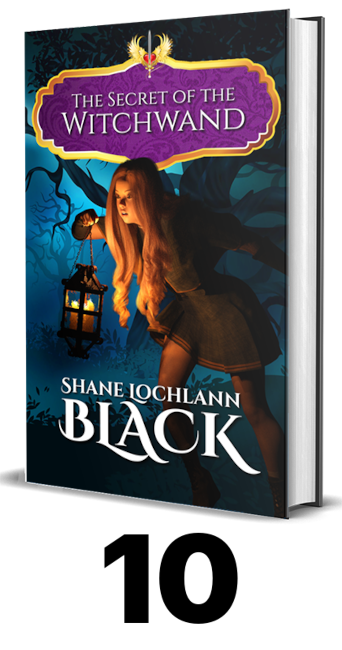
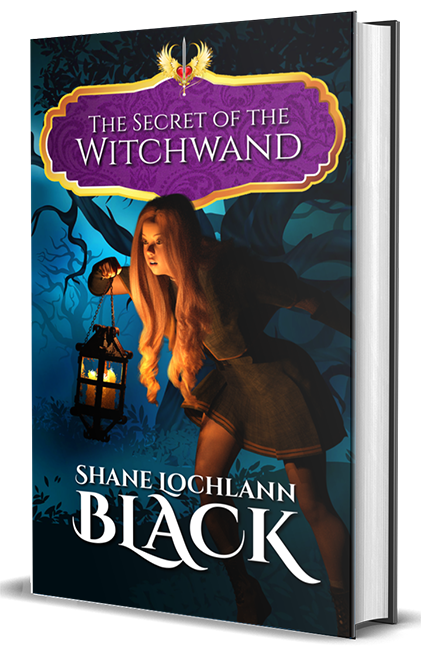
We just hit our first milestone last night. The first book from the Action Faction is set to be shipped as soon as it arrives. We are contributing brand new paperbacks or hardcovers of my YA fantasy title The Secret of the Witchwand to elementary, middle and high schools as our first title. For every $50 we get in Action Faction sponsorships, we’ll contribute another new paperback or hardcover book.
Jessica Halloran is the first fictional character I created all the way back in 1999. My fantasy books are “noblebright” which is to say they present an optimistic view of the world rather than the cynical alternative of “grimdark.” My books contain many academic lessons that are woven into the stories. If you’ve read my detailed descriptions of future technologies in my science fiction books just imagine that approach being taken to things like history, math, geography and writing.
I believe we can put a book in every school in America. Now I want you to think about that for a minute: Every campus could have at least one brand new book: Public or private, all are eligible. If I succeed, I hope to inspire other authors to do the same. Each book would get us one step closer to a more literate culture, and goodness knows that can’t get here soon enough.
I’m inviting you to help us get to our first $2000 milestone as fast as possible. I think we can do it by Monday, March 2. For $2000 I can get books into every campus in two major school districts here in Southern California. That will be enough to put our project on the map. Everything after that is execution.
The buttons you see after each chapter are pay what you want, which means you’re not limited to $1, $2 or $5. Those are just suggested amounts. Contribute what you can. Every sponsorship earns you credit in the next story and, if you don’t already have one, an Action Faction callsign to go with it!
In the meantime, I will promise you new serialized science fiction here and on Bitbook as often as I can get a chapter written. Let’s encourage students to pick up a book and discover the riches of the printed page. It’s one of the most generous things you can do for them.

Read In Order
Action Faction Sponsors: WOLVERINE
$15/$50
“Point November, flight lead. Estimated time to intercept track Aquarian Ten two minutes.” Meerkat’s voice was all-business. It was the missions that seemed to be simple and un-threatening that often turned out to be surprisingly perilous. For that reason both of the fighters in the Cavalier Three formation were leaving nothing to chance. Everything was being conducted by the book. For purposes of EM protocol, point November represented the range from launch point at which it was no longer hazardous to transmit in the clear. Lieutenant Mors allowed the regulation ten second response interval to pass, then he set his helmet patch to transmit hailing.
“Attention unidentified vessel at two eight mark nine. This is Alliance patrol Cavalier Three on your port quarter. Acknowledge.” In addition to the voice signal, Bongo’s fighter automatically transmitted universal Core System “friendly” and “priority” data packet bursts compatible with almost all commercial and civilian navigation systems. Even if the ship’s communications were completely turned off (which would qualify as a second STC violation to go with the deactivated transponder) the vessel’s universal console and navigational tracking systems would zero in on the transmitting fighters and display a warning along the lines of “Turn on your radio/commlink/transponder device/personal commlink/what have you and follow the instructions you hear – this is not optional.”
The two Yellowjacket fighters were not in any kind of attack posture, but they were listening very carefully to everything happening in and around the position of the civilian vessel. Lieutenant Walsh had Aquarian Ten locked in her SRS systems and by now had identified the model of spacecraft and its displacement. She was also reading five life signs, all human.
Aboard Argent, Commander Shaw turned away from the force command station and slipped her headphones off. “Patrol Cavalier Three has intercepted Aqaurian Ten, sir.”
O’Malley moved back to the conn. “Which button?”
“Four, sir.”
The commander pulled the gray handset off its hook. “Cavalier Three, this is X-ray Oscar. What have you got?”
“Civilian yacht, sir. Displacement just under four thousand tons. High-end long-range engines. Standard power plants. Reading five life signs. No unusual activity or readings. Still no transponder signal. No communications. Basically civvie EMCON alpha.”
“Any change in course?” O’Malley asked as he looked back at the tactical display. His readings hadn’t changed, but that didn’t mean the fighters were getting the same information.
“Still on original course and speed, sir,” Bongo replied. “I’d say they’re on some kind of system-to-system autopilot inbound to one of the inner Rho Theta ports.”
“And at this course and speed?”
“About 18 hours to the closest civilian approach.”
O’Malley sighed. There was no avoiding the regs. “Alright, rattle the cage until the birds are awake. We’re going to have to stop them once they cross the perimeter anyway. We will rendezvous at point two. Argent out.”
“Affirmative Argent. Vectoring for loud intercept. Will report on response.”
Once any ship passed a certain range from a populated system’s primary, spacelane regulations required someone at the controls, even if the ship were being maneuvered with a standard autopilot or programmed navigation. The reasons dated back to an incident over a century before Cavalier Three detected their transponder-dark contact. A passenger ship with nearly sixty souls aboard had connected with a civilian spaceport’s equivalent of the old ILS or Instrument Landing System beacon. The way the mechanism was supposed to function was to negotiate a protocol and then take over the ship’s controls and bring it in for a gentle landing. The regulations at the time were for the pilot of the inbound vessel to manually switch the autopilot off and allow the port to acquire lock. On this vessel, however, the pilot was late returning from a break and the other members of the flight crew didn’t see the request on the flight deck’s console. The passenger spacecraft veered more than a half-mile out of its approach track and was on a collision course with a massive space train carrying hazardous waste from an orbital chemical factory when every alarm on the flight deck went off at once. The crew regained control and manually brought the ship in for a landing without injury or further incident. In exchange for avoiding prosecution four members of the passenger spacecraft’s crew retired abruptly, never to hold flight status again. Two members of the spaceport’s control watch were suspended for a year. All of the Core approach protocols were re-examined and adjusted and all the automated flight controllers were updated to match the new rules.
Unfortunately, not all civilian spacecraft owners were as conscientious about navigation as they were supposed to be.
Bongo’s fighter was equipped with multiple transmitters that operated in both full military and civilian spectra. They were also rather generously equipped with power and signal boost capabilities. The antennas on most spacecraft were sufficient for getting a clear signal from place to place. Yellowjacket strike fighters had considerably more sturdy models, given they were often called upon to get a signal through despite enemy jamming, electronic warfare deployments and even the occasional systems failure. Fighters had triple-redundant transmitter/antenna constructs. Each system was independent of the other two, but when they were deployed in sequence they were capable of raising an unholy racket aboard spacecraft that weren’t specifically tuned to dampen alert signals.
Aquarian Ten’s flight deck began to ring like a desk model telephone the size of a small bread truck. All of her navigational scopes were shifting from positive to negative color schemes very much like the lights of emergency vehicles. If one weren’t aware of the reason for such a din, it would be easy to conclude they were about to collide with something large enough to send the passengers and crew of the ship into the great beyond with an unceremonius thud. Somewhere in the aft section of the vessel, either passengers or crew emerged from a stateroom and blundered down the central access corridor to the bridge. After a few moments of attempting to gain bearings, the universal “you cannot ignore this transmission” alert was acknowledged by the vessel’s autosystems. Bongo and Meerkat both saw the frequency shift.
TO BE CONTINUED
$15/$50

Read In Order
Action Faction Sponsors: WOLVERINE, HOOSIER
$15/$50
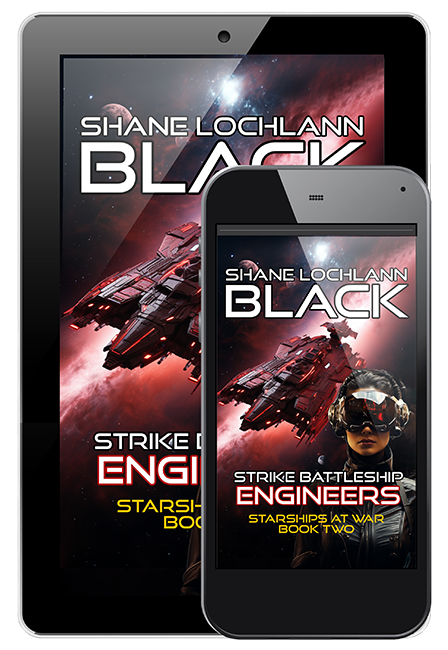
Strike Battleship Argent BBV 740
Rho Theta Frontier
CPT Jason Hunter Commanding
Mission Time 3888.22 Tango Zulu
“Threat board!”
It wasn’t the raised voice. It was the phrase that jolted everyone on the Argent bridge out of their routine. While the Rho Theta system was closer to enemy sectors than the inner Core systems, there were no credible hostile forces within several light years of Argent’s current patrol station.
“Designate new contact Aquarian Ten. Bearing four six mark twelve range 56 megaclicks. On approach course moderate velocity. Estimated time to outer weapons perimeter eight minutes.”
Commander Cochrane O’Malley’s mind was less concerned with the position of the contact and more concerned with why it had tripped his ship’s early warning systems. DSS Argent was equipped with some of the most sophisticated defensive tracking systems in the fleet. Absent an extraordinary cloaking device, it was almost impossible to maneuver close enough to engage Captain Hunter’s ship without having been tracked for a full minute or longer. This distant defensive envelope was only extended and enhanced if Argent had electronic warfare corvettes launched.
“Any reason the battle comp thinks its hostile?” O’Malley asked as he checked off fuel consumption reports on his tablet.
“Most likely issue is Aquarian Ten has no transponder signature. LRS picked it up off emissions only. Based on course, speed and field configuration I’d say we’re looking at a small civilian spacecraft. Perhaps two to five thousand tons. No EM profile,” the tac officer replied.
“Force command who is on ready alert?”
“Bongo and Meerkat, commander,” Deputy Star Wing Commander Shaw replied. “Jacks off Flight Three.”
“Very well,” O’Malley said, turning his attention to the main viewer, where Aquarian Ten was pinpointed on its approach from an out-system position into Rho Theta space. Argent had roughly 28 degrees of the outer orbit inside its own LRS range. Anything approaching from the direction of El Rey would likely be picked up before crossing the orbit of the Proximan Listening Post at system’s edge. This was a vital patrol vector, since El Rey was one potential origin for inbound Imperial warships or probes. “Launch the ready alert. Vector four six. Commit spacecraft. I want an ID pass on unident Aquarian Ten.”
“Affirmative.” Lieutenant Desiree Shaw turned to the force command station and switched all four command nets. “Skywatch, this is force command. Launch Bongo and Meerkat off alert five. Your signal is commit. Vector four six for bogey.”
The controller high above Argent’s dorsal armor plates calmly shifted into action, turning to the enormous flight console where the ship’s entire launch apparatus was displayed with real time information on the status of every active spacecraft aboard. The two rail tunnels on the starboard lateral edge of the third of Argent’s three enormous flight decks were highlighted. “Acknowledged. The board is green. Flight three is cleared controls. Signal launch.”
Lieutenant JGs Alfred “Bongo” Mors and Eileen “Meerkat” Walsh had been harness-closed and idling in their rail tunnels for several minutes by the time the order finally released control to their fighters. The accelerator currents went active and both 2G Yellowjacket spacecraft screamed through their respective rail tunnels and rocketed into space at close to four miles per second velocity. They rapidly banked into their courses and moved into a follow quarter-formation before activating their drive fields and vanishing into the blackness at 0.3c
Bongo activated his commlink. “Skywatch. Ready alert is in space. Designate patrol Cavalier Three. We have the unident on our scope. Estimated time to intercept four minutes.”
To an inexperienced observer, one might wonder why Argent didn’t simply hail the unidentified ship and order it to identify itself and state the reason for the deactivated transponder. Civilian spacelane regulations were as clear as they could be. There were no circumstances, emergency or otherwise, why any spacecraft, absent a military vessel with appropriate authorization, would navigate in-system without an active transponder. There were only two situations where a “dark contact” was tolerated, and those were specific equipment failure or a mayday signal. Since it would almost certainly take a close range rifle shot to cause a bog-standard civilian transponder device to malfunction, and a second shot to disable its backup, the only possibility here was some kind of emergency. The commander had already advised the DSCOM a Tranquility might be needed. Everything was standing by no matter what the problem was.
In the meantime, the reason for the radio silence was well understood. Ordering a ready alert to intercept the contact was far less risky than broadcasting a challenge, especially at this range. Fighters could be coming from anywhere. Once Argent transmitted on an open hailing frequency, O’Malley would be giving away his position. Unlike the civilian contact, Argent was always protected by at least one layer of low-grade electronic counter-measures which made it extremely difficult to pick the ship up at ranges of more than three to five megaclicks. An open transmission would defeat those precautions.
Normally this would be a situation that would warrant a heads-up for the captain. However, Jason Hunter was just starting his fifth hour of rack time having stayed on for half of third watch the night before to cover for the doctor who had spent the night before that treating two galley crewmen who pulled the wrong stack of equipment on a shelf and learned a valuable lesson about gravity and momentum in exchange for a rotator cuff strain, a contusion and two broken fingers. Senior officers needed down time. If they were roused every time the ship encountered a routine series of operations, none would ever sleep. Only two other department chiefs were awake, but both Commander Tixia and Colonel Moody were off duty and likely unconscious as well. It was up to O’Malley and second watch to solve the gripping mystery of the missing transponder on their own.
TO BE CONTINUED
$10/$50