Priority Signal

Attack Pattern Blast Five

Read In Order
Action Faction Sponsors: WOLVERINE

Progress Towards Next New Book Sent to Schools

$15/$50


“Attention unidentified vessel at two one mark fifteen. This is Alliance patrol Cavalier Three on your port edge. Acknowledge this transmission immediately on civilian frequency three one zero.” By now the two Jack fighters were banking in a slow orbit of their contact, maneuvering in perfect one-two follow formation.

The patch thumped as the transmitter engaged. “Yes yes, what is it?” Lieutenant Walsh resisted the urge to roll her eyes. Transmitting without identification was almost conclusive proof there was nobody aboard who had any clue about civilian navigation.

“This is Lieutenant JG Alfred Mors leading patrol Cavalier Three. You have entered the command zone of a Skywatch warship in civilian spacelanes with no active transponder. You are ordered to alter course to the following coordinates. We will escort you to your next waypoint. Acknowledge.”

There was a long pause, during which it was likely an argument was taking place on the vessel’s intraship.

“Thanks for your concern, but we are headed for the outpost port on RT4. This is a passenger ship. We’re not in the military.”

“Acknowledged. We have orders to escort you to the waypoint displayed on your navigational board. An automatic sequence has been transmitted to your vessel’s autosystems. Please engage as instructed.”

“What gives you the right to tell us where to go?!” The voice on the commlink grew rather tense in short order.

“You are in a military command zone. Please engage the automatic navigational system.”

“You didn’t answer my question. Who are you and where do you get–”

“The captain of the Skywatch warship that located you at system’s edge navigating without an active transponder has the authority to interdict your vessel and seize it if necessary.”

“And what happens if we refuse to enagage this navigational directive?”

“We’re offering you a friendly escort to a safe port. If you refuse, a heavier vessel will tractor you to your waypoint. Please do as we have instructed.”

Almost a full minute later, Aquarian Ten’s navigational systems reduced their security posture. The autosystems course was laid in and activated and the small passenger boat altered course to rendezvous with Argent at the designated coordinates.

Almost exactly one hour later, Commander Cochrane O’Malley stepped off the magneto-lifts on to Flight Deck One. One of the second watch crew supervisors met him at the gate.

“What’s the story?”

“We performed a standard inspection, sir. Nice ship. Their transponder has a setting that deactivates it out-system once they reach their point of origin’s jump gate or navigational perimeter. Unfortunately they never turned it back on. We showed the boat’s owner where the setting was and how to keep it from staying dark after the automatic configuration interval.”

“Very well.”

“Medical staff are completing examinations. They’ll be ready to depart in about ten minutes.”

“Understood, chief. Thanks for your help,” O’Malley replied. Aquarian Ten was a nice ship. It looked rather out of place parked at an odd angle on Argent’s port-side flight deck, but it wasn’t damaged or poorly maintained.

“Are you the captain!?” The tone of the voice made it clear O’Malley would have to employ his most diplomatic personality.

“No sir. I’m the executive officer. Cochrane O’Malley.” The commander extended his hand, which was shaken in a reluctantly friendly greeting. The man speaking for the five-member crew of Aquarian Ten looked to be middle-age and somewhat disheveled. It was apparent they had planned to sleep their way to their arrival on Rho Theta Four.

“I want to speak to the captain.”

“He is unavailable at the moment. I am in command of this vessel. You’ll have to settle for me.”

“Do you really have to send armed fighters to roust a five-man boat? We already had a long exhausting trip.” The other four had alternately unfriendly and annoyed expressions. Two were cradling cups of coffee provided by Argent’s quartermaster’s mate.

“We have standard procedures we have to follow. A boat flying with no transponder trips our security systems. We send out an intercept patrol to make sure you aren’t experiencing an emergency of some kind.”

“I’d like to say a few words about that procedure!”

“Feel free to take it up with your representative, sir. My job is to make sure unfriendly ships don’t suddenly appear over a population center with charged weapons. I’m sure you understand.”

O’Malley’s commlink sounded.

The man grumbled in response. He had rapidly tired of the exchange, and the commander was pretty sure he didn’t want to continue arguing either. “We’ll have you underway in a few minutes. Excuse me.” O’Malley stepped away.

“XO here.”

“Sir, we’re receiving a priority signal. Vessel engaged. Location Hammer’s Tomb.”

“Identity?”

“It’s the Spruance, sir.”

“That’s Commander Teller’s ship!”

“Affirmative.”

“Let me get our guests back on their itinerary. Lay in a course for the Atlantis frontier and stand by to maneuver. Set A-Con Two throughout the ship. I’m on my way to the bridge.”

TO BE CONTINUED

Progress Towards Next New Book Sent to Schools

$15/$50

Choose Your Sponsor Level – Pay What You Want – Not a Subscription

Point November

Attack Pattern Blast Four

Read In Order
Action Faction Sponsors: WOLVERINE

Progress Towards Next New Book Sent to Schools

$15/$50
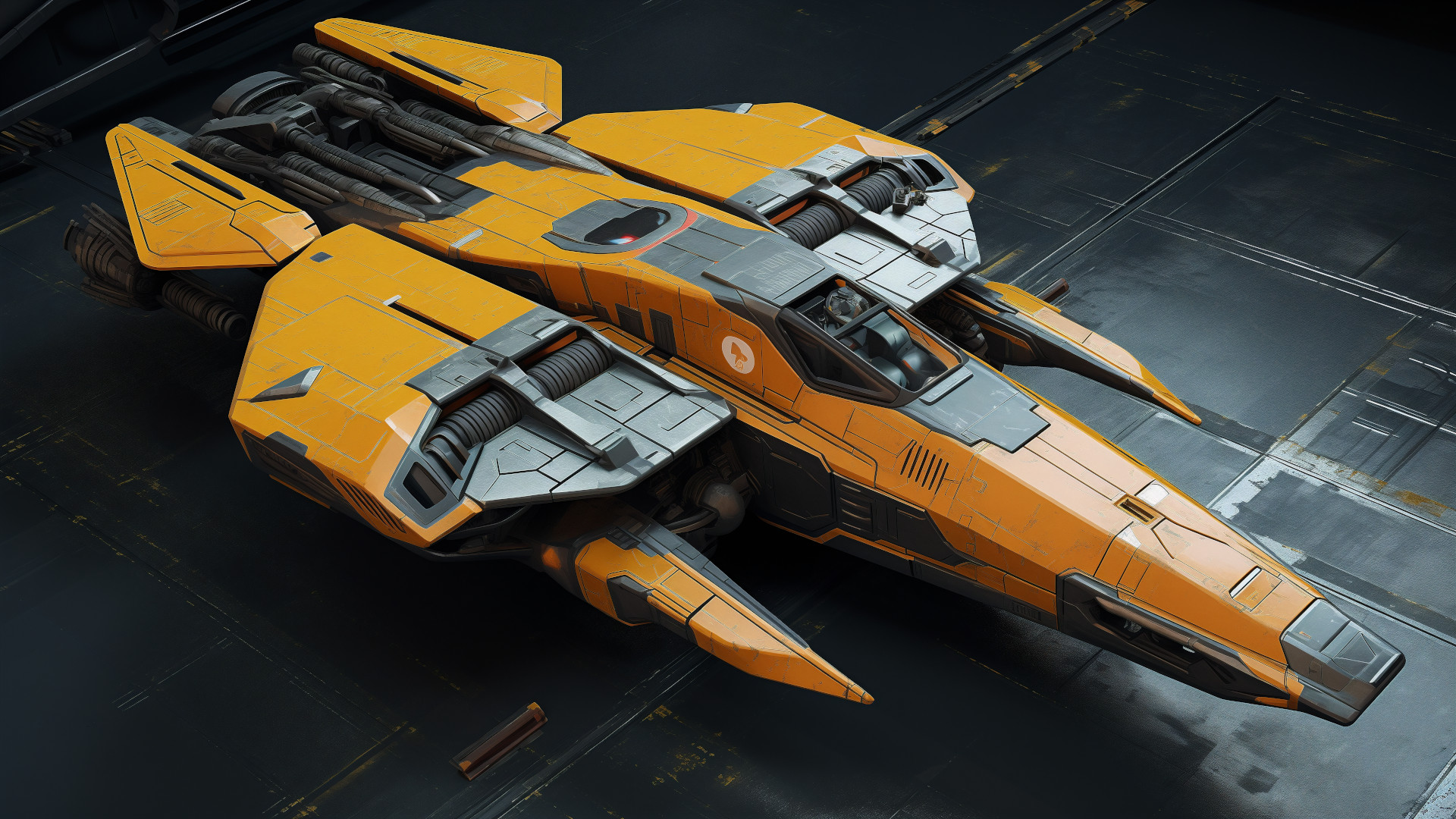

“Point November, flight lead. Estimated time to intercept track Aquarian Ten two minutes.” Meerkat’s voice was all-business. It was the missions that seemed to be simple and un-threatening that often turned out to be surprisingly perilous. For that reason both of the fighters in the Cavalier Three formation were leaving nothing to chance. Everything was being conducted by the book. For purposes of EM protocol, point November represented the range from launch point at which it was no longer hazardous to transmit in the clear. Lieutenant Mors allowed the regulation ten second response interval to pass, then he set his helmet patch to transmit hailing.

“Attention unidentified vessel at two eight mark nine. This is Alliance patrol Cavalier Three on your port quarter. Acknowledge.” In addition to the voice signal, Bongo’s fighter automatically transmitted universal Core System “friendly” and “priority” data packet bursts compatible with almost all commercial and civilian navigation systems. Even if the ship’s communications were completely turned off (which would qualify as a second STC violation to go with the deactivated transponder) the vessel’s universal console and navigational tracking systems would zero in on the transmitting fighters and display a warning along the lines of “Turn on your radio/commlink/transponder device/personal commlink/what have you and follow the instructions you hear – this is not optional.”

The two Yellowjacket fighters were not in any kind of attack posture, but they were listening very carefully to everything happening in and around the position of the civilian vessel. Lieutenant Walsh had Aquarian Ten locked in her SRS systems and by now had identified the model of spacecraft and its displacement. She was also reading five life signs, all human.

Aboard Argent, Commander Shaw turned away from the force command station and slipped her headphones off. “Patrol Cavalier Three has intercepted Aqaurian Ten, sir.”

O’Malley moved back to the conn. “Which button?”

“Four, sir.”

The commander pulled the gray handset off its hook. “Cavalier Three, this is X-ray Oscar. What have you got?”

“Civilian yacht, sir. Displacement just under four thousand tons. High-end long-range engines. Standard power plants. Reading five life signs. No unusual activity or readings. Still no transponder signal. No communications. Basically civvie EMCON alpha.”

“Any change in course?” O’Malley asked as he looked back at the tactical display. His readings hadn’t changed, but that didn’t mean the fighters were getting the same information.

“Still on original course and speed, sir,” Bongo replied. “I’d say they’re on some kind of system-to-system autopilot inbound to one of the inner Rho Theta ports.”

“And at this course and speed?”

“About 18 hours to the closest civilian approach.”

O’Malley sighed. There was no avoiding the regs. “Alright, rattle the cage until the birds are awake. We’re going to have to stop them once they cross the perimeter anyway. We will rendezvous at point two. Argent out.”

“Affirmative Argent. Vectoring for loud intercept. Will report on response.”

Once any ship passed a certain range from a populated system’s primary, spacelane regulations required someone at the controls, even if the ship were being maneuvered with a standard autopilot or programmed navigation. The reasons dated back to an incident over a century before Cavalier Three detected their transponder-dark contact. A passenger ship with nearly sixty souls aboard had connected with a civilian spaceport’s equivalent of the old ILS or Instrument Landing System beacon. The way the mechanism was supposed to function was to negotiate a protocol and then take over the ship’s controls and bring it in for a gentle landing. The regulations at the time were for the pilot of the inbound vessel to manually switch the autopilot off and allow the port to acquire lock. On this vessel, however, the pilot was late returning from a break and the other members of the flight crew didn’t see the request on the flight deck’s console. The passenger spacecraft veered more than a half-mile out of its approach track and was on a collision course with a massive space train carrying hazardous waste from an orbital chemical factory when every alarm on the flight deck went off at once. The crew regained control and manually brought the ship in for a landing without injury or further incident. In exchange for avoiding prosecution four members of the passenger spacecraft’s crew retired abruptly, never to hold flight status again. Two members of the spaceport’s control watch were suspended for a year. All of the Core approach protocols were re-examined and adjusted and all the automated flight controllers were updated to match the new rules.

Unfortunately, not all civilian spacecraft owners were as conscientious about navigation as they were supposed to be.

Bongo’s fighter was equipped with multiple transmitters that operated in both full military and civilian spectra. They were also rather generously equipped with power and signal boost capabilities. The antennas on most spacecraft were sufficient for getting a clear signal from place to place. Yellowjacket strike fighters had considerably more sturdy models, given they were often called upon to get a signal through despite enemy jamming, electronic warfare deployments and even the occasional systems failure. Fighters had triple-redundant transmitter/antenna constructs. Each system was independent of the other two, but when they were deployed in sequence they were capable of raising an unholy racket aboard spacecraft that weren’t specifically tuned to dampen alert signals.

Aquarian Ten’s flight deck began to ring like a desk model telephone the size of a small bread truck. All of her navigational scopes were shifting from positive to negative color schemes very much like the lights of emergency vehicles. If one weren’t aware of the reason for such a din, it would be easy to conclude they were about to collide with something large enough to send the passengers and crew of the ship into the great beyond with an unceremonius thud. Somewhere in the aft section of the vessel, either passengers or crew emerged from a stateroom and blundered down the central access corridor to the bridge. After a few moments of attempting to gain bearings, the universal “you cannot ignore this transmission” alert was acknowledged by the vessel’s autosystems. Bongo and Meerkat both saw the frequency shift.

TO BE CONTINUED

Progress Towards Next New Book Sent to Schools

$15/$50

Choose Your Sponsor Level – Pay What You Want – Not a Subscription

Unidentified Contact

Attack Pattern Blast Three

Read In Order
Action Faction Sponsors: WOLVERINE, HOOSIER

Progress Towards Next New Book Sent to Schools

$15/$50
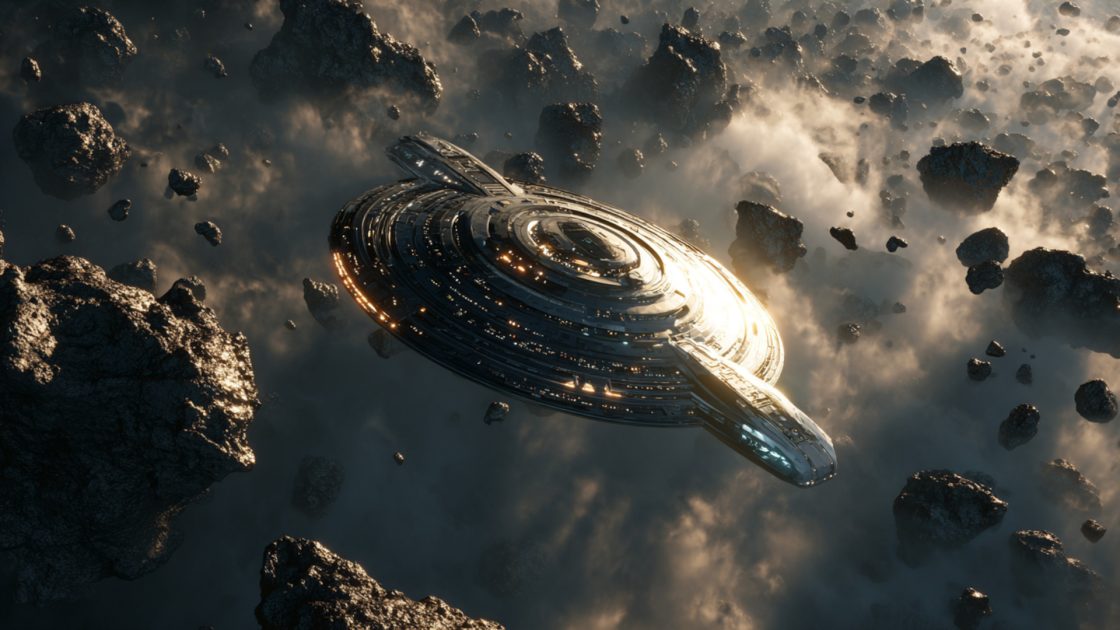

Strike Battleship Argent BBV 740
Rho Theta Frontier
CPT Jason Hunter Commanding
Mission Time 3888.22 Tango Zulu

“Threat board!”

It wasn’t the raised voice. It was the phrase that jolted everyone on the Argent bridge out of their routine. While the Rho Theta system was closer to enemy sectors than the inner Core systems, there were no credible hostile forces within several light years of Argent’s current patrol station.

“Designate new contact Aquarian Ten. Bearing four six mark twelve range 56 megaclicks. On approach course moderate velocity. Estimated time to outer weapons perimeter eight minutes.”

Commander Cochrane O’Malley’s mind was less concerned with the position of the contact and more concerned with why it had tripped his ship’s early warning systems. DSS Argent was equipped with some of the most sophisticated defensive tracking systems in the fleet. Absent an extraordinary cloaking device, it was almost impossible to maneuver close enough to engage Captain Hunter’s ship without having been tracked for a full minute or longer. This distant defensive envelope was only extended and enhanced if Argent had electronic warfare corvettes launched.

“Any reason the battle comp thinks its hostile?” O’Malley asked as he checked off fuel consumption reports on his tablet.

“Most likely issue is Aquarian Ten has no transponder signature. LRS picked it up off emissions only. Based on course, speed and field configuration I’d say we’re looking at a small civilian spacecraft. Perhaps two to five thousand tons. No EM profile,” the tac officer replied.

“Force command who is on ready alert?”

“Bongo and Meerkat, commander,” Deputy Star Wing Commander Shaw replied. “Jacks off Flight Three.”

“Very well,” O’Malley said, turning his attention to the main viewer, where Aquarian Ten was pinpointed on its approach from an out-system position into Rho Theta space. Argent had roughly 28 degrees of the outer orbit inside its own LRS range. Anything approaching from the direction of El Rey would likely be picked up before crossing the orbit of the Proximan Listening Post at system’s edge. This was a vital patrol vector, since El Rey was one potential origin for inbound Imperial warships or probes. “Launch the ready alert. Vector four six. Commit spacecraft. I want an ID pass on unident Aquarian Ten.”

“Affirmative.” Lieutenant Desiree Shaw turned to the force command station and switched all four command nets. “Skywatch, this is force command. Launch Bongo and Meerkat off alert five. Your signal is commit. Vector four six for bogey.”

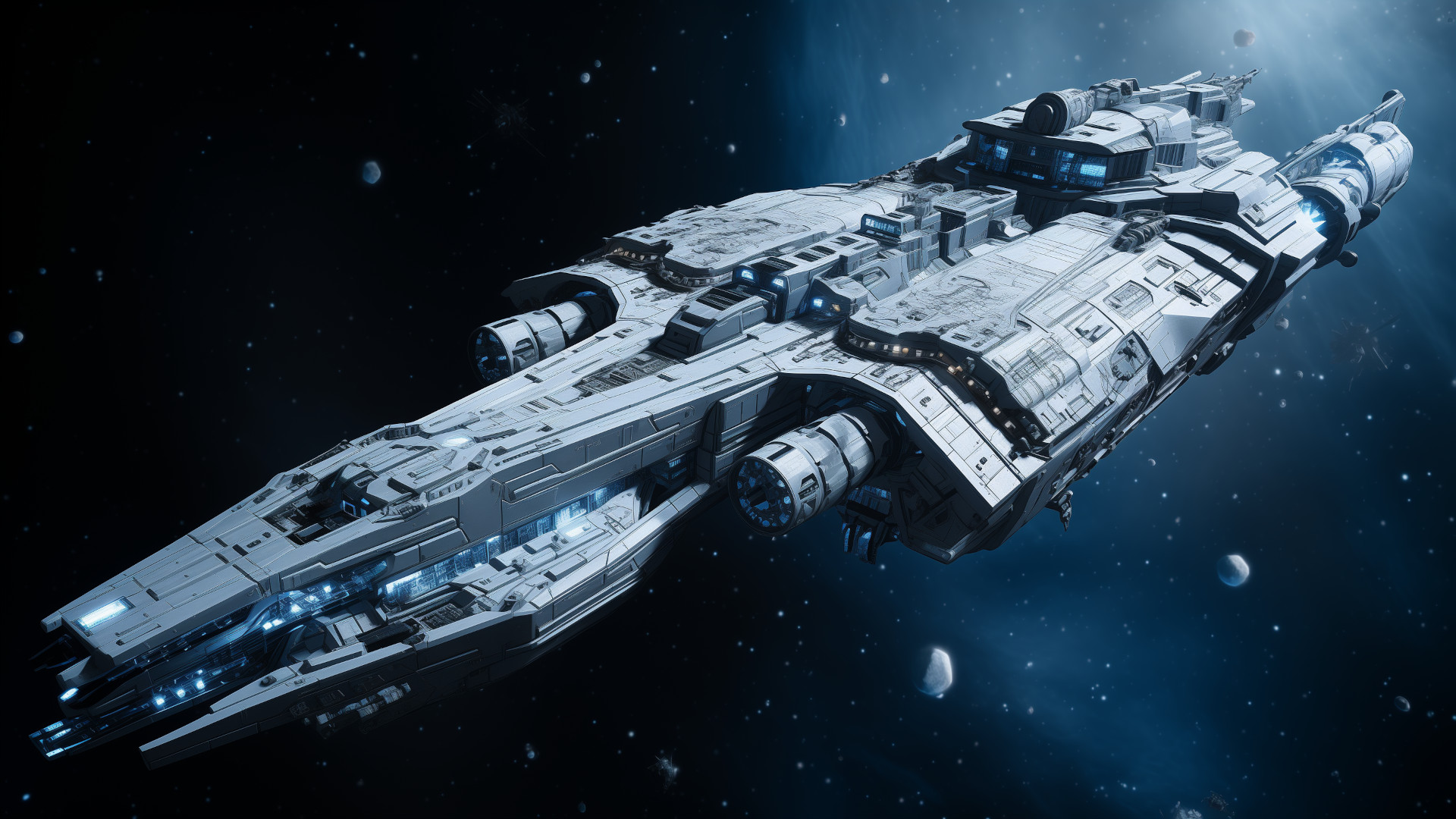
The controller high above Argent’s dorsal armor plates calmly shifted into action, turning to the enormous flight console where the ship’s entire launch apparatus was displayed with real time information on the status of every active spacecraft aboard. The two rail tunnels on the starboard lateral edge of the third of Argent’s three enormous flight decks were highlighted. “Acknowledged. The board is green. Flight three is cleared controls. Signal launch.”

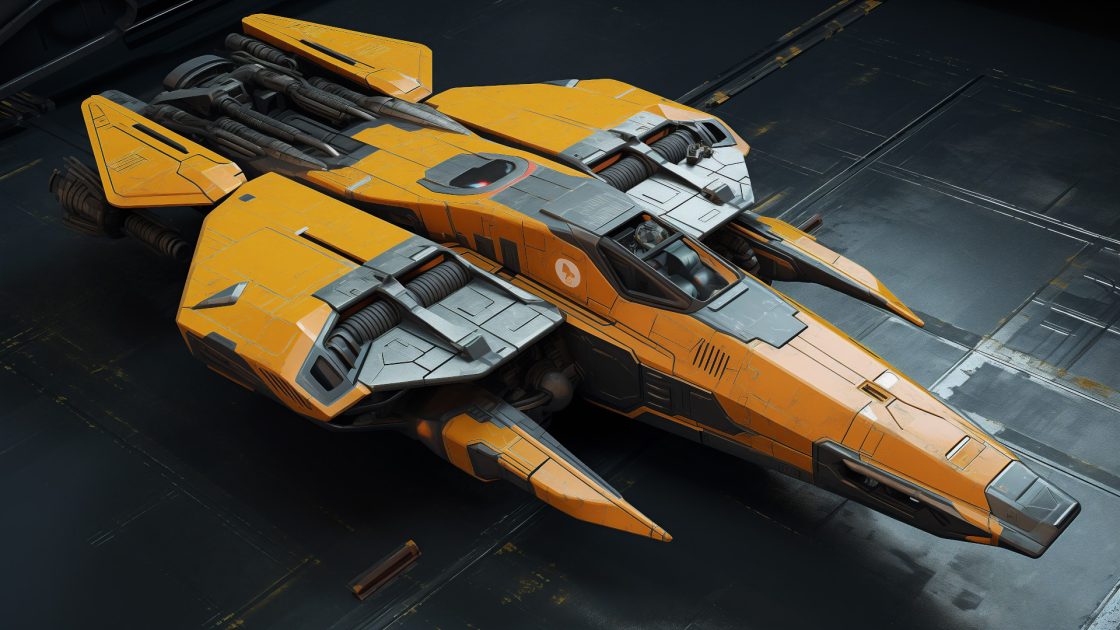
Lieutenant JGs Alfred “Bongo” Mors and Eileen “Meerkat” Walsh had been harness-closed and idling in their rail tunnels for several minutes by the time the order finally released control to their fighters. The accelerator currents went active and both 2G Yellowjacket spacecraft screamed through their respective rail tunnels and rocketed into space at close to four miles per second velocity. They rapidly banked into their courses and moved into a follow quarter-formation before activating their drive fields and vanishing into the blackness at 0.3c

Bongo activated his commlink. “Skywatch. Ready alert is in space. Designate patrol Cavalier Three. We have the unident on our scope. Estimated time to intercept four minutes.”

To an inexperienced observer, one might wonder why Argent didn’t simply hail the unidentified ship and order it to identify itself and state the reason for the deactivated transponder. Civilian spacelane regulations were as clear as they could be. There were no circumstances, emergency or otherwise, why any spacecraft, absent a military vessel with appropriate authorization, would navigate in-system without an active transponder. There were only two situations where a “dark contact” was tolerated, and those were specific equipment failure or a mayday signal. Since it would almost certainly take a close range rifle shot to cause a bog-standard civilian transponder device to malfunction, and a second shot to disable its backup, the only possibility here was some kind of emergency. The commander had already advised the DSCOM a Tranquility might be needed. Everything was standing by no matter what the problem was.

In the meantime, the reason for the radio silence was well understood. Ordering a ready alert to intercept the contact was far less risky than broadcasting a challenge, especially at this range. Fighters could be coming from anywhere. Once Argent transmitted on an open hailing frequency, O’Malley would be giving away his position. Unlike the civilian contact, Argent was always protected by at least one layer of low-grade electronic counter-measures which made it extremely difficult to pick the ship up at ranges of more than three to five megaclicks. An open transmission would defeat those precautions.

Normally this would be a situation that would warrant a heads-up for the captain. However, Jason Hunter was just starting his fifth hour of rack time having stayed on for half of third watch the night before to cover for the doctor who had spent the night before that treating two galley crewmen who pulled the wrong stack of equipment on a shelf and learned a valuable lesson about gravity and momentum in exchange for a rotator cuff strain, a contusion and two broken fingers. Senior officers needed down time. If they were roused every time the ship encountered a routine series of operations, none would ever sleep. Only two other department chiefs were awake, but both Commander Tixia and Colonel Moody were off duty and likely unconscious as well. It was up to O’Malley and second watch to solve the gripping mystery of the missing transponder on their own.

TO BE CONTINUED

Progress Towards Next New Book Sent to Schools

$10/$50


Choose Your Sponsor Level – Pay What You Want – Not a Subscription

A New Enemy Opens Fire on DSS Spruance

Attack Pattern Blast Two

Read In Order
Action Faction Sponsors: WOLVERINE

Progress Towards Next New Book Sent to Schools

$10/$50


Whiskey Grain took a well-earned drag on his half-cigar. Although his ship was decidedly inferior to the monster chasing her, he had the advantage of being on his home field. He knew every scar and bruise in and around the space of Hammer’s Tomb. He had been in physical contact with every planet in the system, even the ones that better resembled fields of debris instead of worlds. He considered the dying red star at the center of his stomping grounds a brother of sorts. Aside from the most obsessive astrophysicists, he had compiled more knowledge about the crimson sun and its would be assassin at the center of the 100 AU event horizon that crept closer every moment.

His objective was obvious, at least for the band of outlaw prospectors he led. Skywatch didn’t belong out here. In fact, humanity in general wasn’t supposed to be snooping around beyond the cosmic “no trespassing” sign Omicron was supposed to be. Spruance’s sudden arrival at a position only a few megaclicks off the wandering asteroids of the Focal Cluster was more than a navigational blunder or explainable encroachment. It was provocative in all the wrong ways, and it had to be dealt with immediately.

The “Roidbusters,” as they had come to be known, were not a sophisticated tribe. They were, for lack of a better description, the combination of spaceflight technology, a junkyard the size of Canada and a devil-may-care population of radiation-poisoned fortune seekers who had forgotten more about materials science than most professors of the subject matter would ever learn. They had entirely unorthodox ways of getting from place to place, using what they found in bizarre and surprisingly effective ways, and defending their turf with a combination of sociopathy and resourcefulness that strained the definition of the word “unpredictable.”

Captain Grain’s ship was the Maiden’s Ransom. She was a specialized combination of a frontier enforcement frigate and an extremely capable cobalt prospecting vessel. The ship had facilities aboard that could package cobalt debris together with an innovative detonator that turned the entire affair into a concentrated cloud of fast-moving and viciously superheated radioactive debris. They were the spaceflight equivalent of cluster bombs with extra features, and they were nightmarishly effective against crews that weren’t prepared for them. The static versions of Grain’s weapons were used as standoff mines in contested areas of space. The kinetic versions were “launched” like depth charges. Crews in pressurized hazard armor physically rolled the devices through a shielded airlock directly into space. Once they emerged from their ship’s magnetic field, they activated a set of precision sensors that looked for enemy vessel drive fields and then used those fields as polarized supermagnets. The weapon actually “pulled itself” towards its target until it reached optimium range, then it exploded into a cloud of astronomically hot ionized spinning debris that formed a massive wall in the path of an oncoming ship.

The results of the collision between that cloud and an enemy vessel were rarely pleasant, at least for Grain’s enemies.

The Roidbusters honestly didn’t give two dragoons for what shoving matches were taking place between Imperial forces, Skywatch, the pompous felines of Proxima or anyone else for that matter. They were perfectly content to distill their terribly bitter alcoholic beverages, listen to music that had been declared virtually illegal in every sane jurisdiction and break their rocks to look for hot minerals and the occasional precious stone. They were civilization’s edge case: maintainers of markets where the exiles from polite society went when conventional ways of life turned sideways. They were the galaxy’s truck drivers. Every one of them was in possession of at least three categories of contraband, hiding a shotgun somewhere on their person, and carrying enough cash to establish an unlicensed open-air liquor store on three hours notice.

They were also all suffering from varying types of radiation sickness. Fortunately, they were also one of the most accomplished groups of space travelers when it came to treating exposure to radioactive substances. Among their advancements were an entire class of mineral alloys that served as almost perfect shields against all kinds of dangerous elements, a highly experimental branch of chemistry that allowed numerous species to use rare serums to treat exposure and tissue damage and electronics that were so sensitive they could detect and classify valuable ionized metals at extreme ranges.

It wasn’t often a Roid ship angered a Skywatch crew, but when they did they had a few tricks up their soiled sleeves. The most important was stolen and heavily modified drive tech that made their ships unusually fast. This often baited enemies into pursuit gambits, which were always riskier for the pursuer than the pursuee. Captain Grain was about to make that last point the central reality in the lives of every member of Teller’s crew. He took the burning cigar fragment out of his teeth. Smoke rose to surround his grizzled face.

“Release.”

Maiden’s Ransom dove away as three cobalt contact mines drifted into her wake. All three obtained nearly instant locks on the furious oncoming drive field that surrounded the Skywatch cruiser Spruance. They accelerated into the larger ship’s path exactly as designed.

“Threat board!” Teller’s tactical officer rose to his feet. His shock harness fell away as he lunged forward, desperately trying to maintain sight of the horror story being told by his instruments. “Weapons in space! Vampire! Vampire!”

“Helm! Hard over! Emergency evasive!”

Spruance’s pilot knew his ship had about a 2% chance of surviving the order her captain had just given, so he split the difference and attempted a roll maneuver that wouldn’t create the same course delta but would potentially keep the cruiser’s lateral edges out of the path of whatever was coming their way. The problem was Roidbuster weapons didn’t work like missiles. They operated more like ink clouds from octopi. Simply touching them was enough to plunge an enemy vessel into the interplanetary equivalent of a zone of darkness.

Cobalt weapon one detonated at a range of only 727 miles. Spruance had hundredths of a second to react, which made humans ineffective practically by default. The time it took for human nerve impulses to reach muscles was far too long for such narrow tolerances. Weapon two detonated 0.6 seconds later. Spruance veered port, sidestepped the fast moving cloud of death released by weapon one and screamed directly into the center of cloud two.

The vessel’s battle computer, which was able to react quite a bit faster than the men and women who programmed it, scrammed the ship’s weapons systems all at once. Sixteen overloaded fusion torpedos fired in one massive barrage and instantly impacted the dense wall of junk that cobalt mine two had jettisoned into space. The closest torpedo detonated at nine miles and flattened Spruance’s starboard shields. A second fusion burst went off aft of the cruiser’s position and knocked out her engines. Teller’s drive field fluctuated and collapsed. The sudden re-introduction of Newtonian physics almost overcame the automatic safety mechanisms built into Spruance’s shields. The ship expended the very last watt of energy in its battle screens to keep its hull in one piece. The remaining torpedos slammed and yanked the cruiser as it spiraled out of position. A final blast punched the port hull and threw the ship into an uncontrolled flat spin.

Lieutenant Bart Morley staggered to the conn and knelt by the captain. He turned Teller over and saw the bloodsoaked face of a man who had given the last of his strength to defend human populations. The commander was alive, but he would need heroic medical intervention.

“XO to sickbay! Medical teams to the bridge!” Something that sounded like a combination of a faraway shout and growling static crackled over the 1MC. “Get me a damage report!”

All Morley could hear was coughing and the thrum of below-decks energy and automatic defensive systems attempting to address the near-fatal impact Spurance had just suffered. “Helm! Status! Does the bridge have positive control!”

“Aye, sir. Bridge has control of the rudder!” came the tentative reply. There was too much smoke drifting through the bridge to see the helm clearly from the conn. A fire had broken out at navigation and was being put out by two able crewmen with a portable suppressor.

“Thrusters and engines at station keeping!”

“Negative, lieutenant! Engines off-line! Only aft thrusters are responding. Our drive field is down. Screens are down. Spruance is drifting!”

What Morley and his remaining officers didn’t know was Maiden’s Ransom had reversed course. She was approaching Spruance’s position with the rest of her weapons fully charged and locked.

TO BE CONTINUED

Progress Towards Next New Book Sent to Schools

$10/$50


Choose Your Sponsor Level – Pay What You Want – Not a Subscription

DSS Spruance Pursues an Enemy Spacecraft at Hammer’s Tomb

Attack Pattern Blast One

Read In Order
Action Faction Sponsors: WOLVERINE

Progress Towards Next New Book Sent to Schools

$10/$50


Fusion Cruiser Spruance CL+ 76
Hammer’s Tomb Deflection Zone
CDR Francis Teller Commanding
Mission Time 3887.16 Tango Zulu

“Hold your course, helm! Thirteen degrees inclination!”

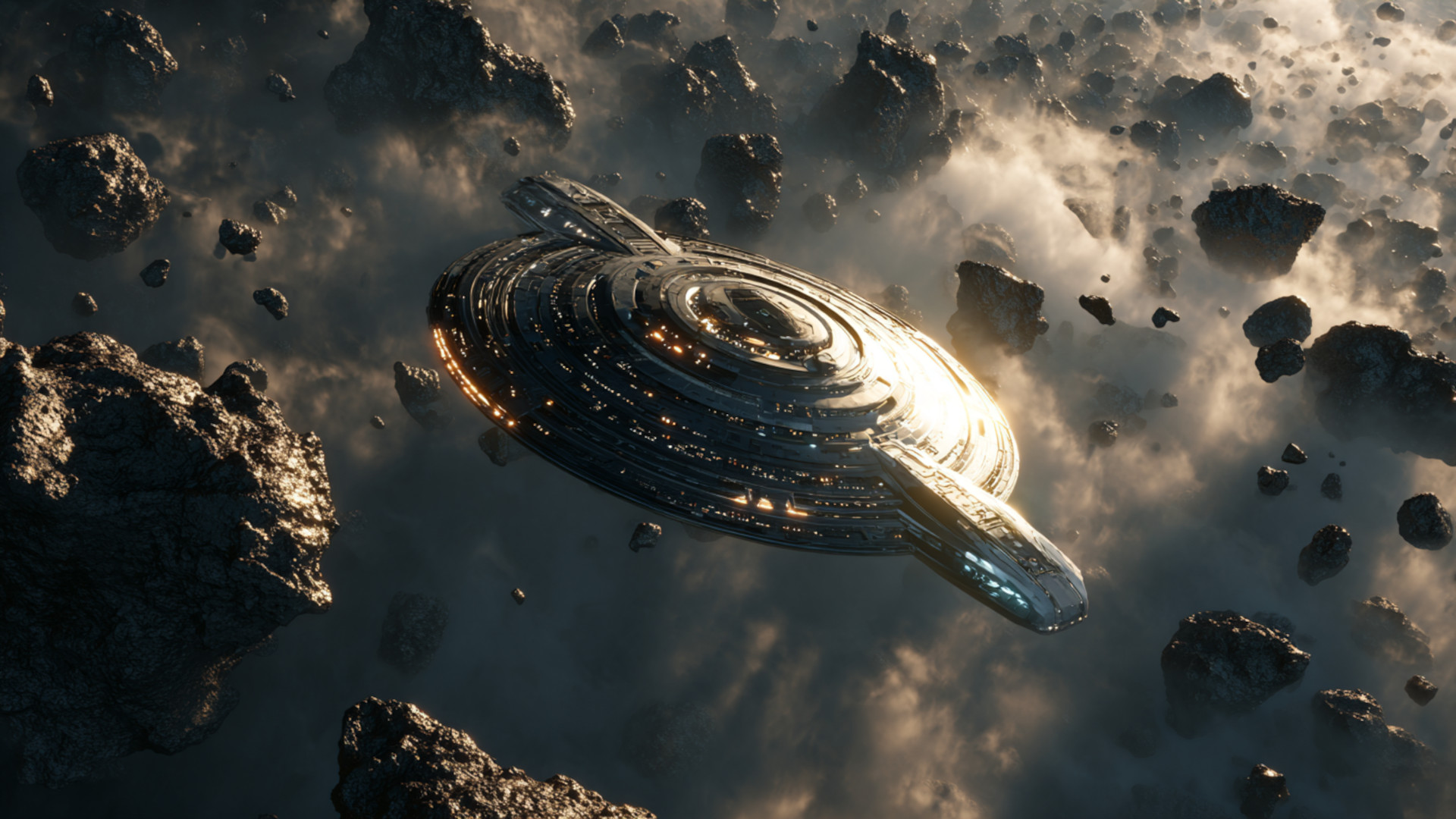
Deck one was rigged for red. The ship was at general quarters. An Alliance upgraded fusion cruiser, carrying one of the most advanced weapons loadouts ever authorized for a Skywatch warship, hurtled through space at alarming speeds, straining against its own drive field. Its enemy was on the run, headed into a star system that had been gradually torn to pieces by the leviathan only one light-hour from its outermost planet’s orbit. The Omicron 474 singularity was not quite in the same kind of hurry as the tiny spacecraft that had spent the better part of two hours navigating past its treacherous gravity distortions, but within a hundred millennia or so, it was expected to tear the insides out of the doomed red sun that dominated the system known as “Hammer’s Tomb.”

The system was technically inside Atlantis space, which made it generally off-limits for Core Alliance vessels, be they military or civilian. That meant it was a secretive haven for the kinds of ships and operations that preferred to remain invisible to Skywatch. There were five planets, only two of which remained intact. The impossibly powerful gravitational forces had pulled the entire system into what amounted to a choreographed decaying orbit. This presented more than a few challenges for guests, not the least of which was the fact that the tidal forces aimed at intact planets or large asteroids were intense enough that surface temperatures were often as much as 200 to 300 degrees higher than normal. The star was gradually accelerating into its decline, pulling everything with it while Omicron applied lateral gravity. While the solar wind from the oversized giant accelerated and gravitational forces created lensing effects that made true navigation by the stars almost impossible, time itself sped up and slowed down at random intervals.

The tactical realities were beyond imagining. Only a madman would voluntarily order their ship into such a place, even if it weren’t marked with the name “Tomb” on star maps. Then again, there was an equally compelling case to be made only a madman would pursue an enemy into the spacetime equivalent of Hell itself.

“We are now inside Atlantis space and in violation of Skywatch regulations!” the XO shouted.

The skipper of DSS Spruance looked ready to leap out of his command chair. His crew wouldn’t have been at all surprised if he did. The roar on the bridge of the recently upgraded Alliance warship was almost unbearable. Only the vessel’s massively overbuilt energy systems were keeping her drive field intact as she howled through space at the edge of one of the most unpredictable systems on Skywatch charts. Only a few hundred miles ahead of her the plasma trailing shadow of her target flickered as it ran for its life. Instruments were unreliable. Inteference was everywhere. Tiny asteroids were burned to ash as they impacted the cruiser’s battle screens.

Not far ahead was contact Reflector Six, the vessel confirmed to have opened fire on both of Spruance’s escorts without provocation.

“Weapons status!” Teller barked.

“Fusion overloads holding, but just barely sir!” the tactical officer responded.

Francis Teller had ordered his cruiser’s newest and heaviest weapons to arm themselves inside their launchers. Spruance was holding eight globes of barely restrained destructive power inside precision tuned magnetic fields so delicately balanced, a variation of half a percent in relative polarities would disrupt the containment shielding and turn a cluster of unrestrained supernovas loose inside the ship’s hull. They were essentially Molotov cocktails that had to be held while lit, at least until the firing ship had a target solution. Overloaded torpedos, on the other hand, were designed to be launched at once, preferably at unimaginable speeds along a vector directly away from the ship and crew. But Teller’s mind was elsewhere. He knew the capabilities of the system, and he knew he could push them if necessary. He didn’t just want to damage his target. He wanted to vaporize it. One thing working in his favor was the fact the space equivalent of an eternal typhoon with 200 foot radioactive waves might do the job before he needed to pull the trigger.

“Go to one hundred ten percent! Shift all reactors blue offsets! Maximum ambient!”

Aboard the new upgraded class of Skywatch warship, an energy officer was posted to the bridge. Their job was to balance fuel and capacitance flows throughout the sleek vessel’s gigantic transmission and storage matrix. Spruance was no longer just a formation cruiser assigned to gunnery in support of a flagship. Now she was a rabid pack animal, engineered for blood hunger and swiftly overtaking prey. Her captain had driven his crew through a 12-week crash course in pure ship versus ship violence while he studied the capabilites of the brand new Jaguar fusion torpedo banks Spruance had acquired. At the moment, however, it was that energy officer who was looking to the XO for help. Commander Teller had ordered his ship’s entire battery to overload status, something which had never been attempted in combat and certainly was never meant to be held in capacitance for long. The stability of the dampening fields was nearing critical.

“Sir, we’ve got thirty seconds before all the line temperatures reach maximum tolerance!” the XO shouted. The rattling and thunderous subsonic vibrations were threatening to create spikes in the bridge’s pressurized atmosphere. The air temperature was approaching 110 degrees Fahrenheit despite the environmental controls’ feverish attempts to restore proper humidity and circulation.

“Get me a target lock, tactical!”

“We can’t close range, sir! Reflector Six drive field integrity is two points above amplitude and climbing!”

Teller pounded his fist on the arm of his command chair. “Damn the weapons lock! Maximum overload aspect for proximity targeting! Bracket pattern!”

“Weapons one and two calibrated. Red charge!”

“Fire!”

The bridge lights dimmed as Spruance’s forward fusion banks each launched two dangerously overloaded bolts of ravenous contained plasma. The weapons shrieked across the inky gloom of space, crossing tens of thousands of miles in fractions of a second. Each punched a strobing hole in the darkness as it detonated. The cruiser heedlessly tore through its own weapons’ shockwaves and continued bearing on its enemy.

“No effect! Reflector Six maintaining range!”

“Fire two!”

Again the power systems fluctuated as the cruiser’s secondary banks each fired twice. Again a barrage of blinding weapons lanced through the void. Painful eruptions of unstable energy flashed and burned in space. Teller’s ship blasted through the unbearable heat and radiation once more, its shields ripping gashes in the spherical bursts. Spruance emerged. Its instruments cleared and rapidly re-acquired their target.

The unidentified attacker was losing speed. Teller’s ship was closing. The commander’s fingers closed tight around the edges of the command consoles on either side of the center seat. If he could overtake Reflector Six his energy banks would have a clean shot at its engines. He needed another ten seconds. Just ten more seconds and his crazed pursuit would bring the enemy vessel within range of his guns.

It was the single-minded fixation on gaining those last few hundred miles that put DSS Spruance squarely inside her enemy’s target envelope.

What Commander Teller didn’t know was that the enemy ship was preparing the kind of attack that didn’t require the enormous energy loads of a fusion cruiser’s weapons. The Jaguar Torpedo system was tremendously capable and far more versatile than most weapons of its type. The Alliance had invested catastrophic amounts of labor, materials and risk to bring them to the battlefield. Fusion torpedos were the weapon that had to work, because the alternative was unthinkable. They were supposed to give captains the option to fire an “energy missile” that didn’t require fuel, guidance systems, complex electronics or a physical vehicle and warhead. Fusion torpedos were weapons with their own modified drive fields guided by the firing ship and its sophisticated targeting scanners rather than on-board tracking. The tradeoff was that the firing ship had to become essentially a fifty-thousand-ton capacitor built around an absolutely massive reactor structure covered with high energy targeting arrays. It did what it was supposed to do, but at a cost. In the great balancing act of firepower vs. defense vs. speed, the super-fast weapon-encrusted fusion cruiser had to give something up.

Unfortunately, Spruance’s enemy and its choice of weapons were about to expose her primary vulnerability.

TO BE CONTINUED

Progress Towards Next New Book Sent to Schools

$10/$50


Choose Your Sponsor Level – Pay What You Want – Not a Subscription